📁
The Education Gap
"It is not beyond our power to create a world in which all children have access to a good education" - Nelson Mandela
THE GAP
achievement.opportunity.education.

📁
The Education Gap
ABOUT
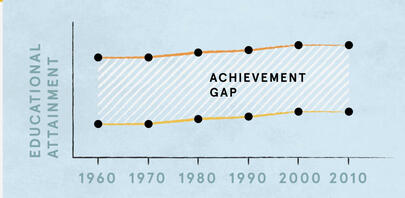
What is the "gap"? The “achievement gap” in education refers to disparities in academic performance between groups of students. The achievement gap shows up in grades, standardized tests, course selection, dropout rates, and college completion rates, etc.
WHY?
There are many factors that are interconnected to the achievement gap making the problem very complex. School-based factors such as inequitable levels of school funding, unequal distribution of highly qualified and experienced teachers, harsh disciplinary policies, minimally articulated core curriculum, and lack of consistent instructional support can be cited as some of the causes that lead to students falling behind
WHO?
Who is affected? To put it briefly, those commonly affected are minorites and those who come from low-income families. Achievement gaps for racial minorities are correlated with gaps in income, poverty rates, unemployment rates, and parents’ education level. The Stanford Center for Policy Analysis found the correlation between achievement gaps and these socioeconomic factors was at least 62% for Black communities and 83% for Latinx communities

GOAL
The gap has been a persistent problem. The gap has gained a fair amount of recognition and there has been action taken to work towards ending the gap and promoting equity for students. However, we still have not seen the gap actually come towards an end. The goal is to end the achievement gap; to provide equal education and opportunities to students to create equity in the school systems and for all students to be supported in their academic enviroment.
📁
The Education Gap
THE FACTS
In California, 1 in 5 Latinx students does not graduate with his or her class and for Black students that number is 1 in 3.
California’s Latinx students attend the nation’s more segregated schools; are often pushed away from college-prep coursework, and are sometimes perceived as less academically capable than their White or Asian peers
Even before the pandemic, many students from low-income schools lacked adequate access to technology and digital resources they need to succeed
Even when black students do have access to honors or advanced placement courses, they are vastly underrepresented in these courses. Black and Latino students represent 38 percent of students in schools that offer AP courses, but only 29 percent of students enrolled in at least one AP course. Black and Latino students also have less access to gifted and talented education programs than white students.
Across the country, black students are assigned more uncertified and novice teachers
The gap begins in elementary school for both Black and Latinx students— by the 4th grade, White students in CA are consistently above state and national averages for math, while Black and Latinx students score below those averages.
Every year, 1.3 million students drop out of high school in the United States. More than half of those students are students of color, and most are low-income. And although these students are born with just as much potential as their more affluent peers, students growing up in low-income communities are 2.5 times less likely to be college-ready.
African American students are often located in schools with less qualified teachers, teachers with lower salaries, and novice teachers.
Students of color are often concentrated in schools with fewer resources. Schools with 90 percent or more students of color spend $733 less per student per year than schools with 90 percent or more white students.

The Education Gap
CLOSING THE GAP
The achievment gap has been an issue that has persisted for years. However, we can close some aspects of the achievement gap and ensure equity and equal opportunities for students in school
MONEY
Money is a huge part of ending the gap. Schools, specifically those with students affected by the achievement gap need financial support for teachers, staff, resources, technology, programs, etc. Most of the money for schools comes from local and state taxes and a little bit of federal money. In 2019 there was about $26 billion that schools needed to get closer to ending the achievement gap. Something to note is that this money is not going to be adequately dispersed; to actually end the gap more money is going to be allocated to schools in high poverty districts because they commonly have low-income students and not many resources.
WHERE DOES THE MONEY COME FROM?
Most of the money for schools comes from local and state taxes and a little bit of federal money.
Because property values and tax rates varied across the state, this approach created large differences in per-pupil funding across districts.
LOTTERY
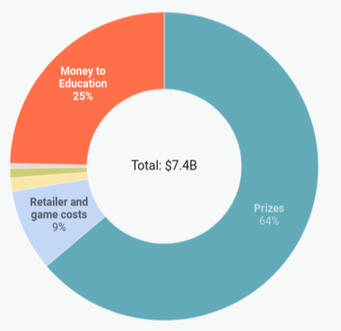
California voters created the State Lottery in 1984. It’s a big operation with about a thousand employees and a substantial marketing presence. About half of all adults in California buy at least one lottery ticket each year, knowing that — win or lose — a portion of the price of the ticket goes to support California’s public K-12 schools and colleges. After prizes and expenses, the lottery pays for about 1% of the California education budget, equivalent to about $200 per student.
The Education Gap
TAXES
Passing a tax measure requires political will — a level of collective agreement that can overcome apathy, distrust, and competing priorities. It requires trust, too — not just that the money to be raised is needed, but that it will be spent well and make a difference. Most voters are more inclined to support taxes that benefit their local community schools than ones that apply to the whole state of California. Also, taxing the wealthy at a higher rate will allow for adequate support and funding of public sectors like public education and support for low-income families.
PROPOSITIONS
Prop 15: Increases funding for K-12 public schools, community colleges, and local governments by requiring that commercial and industrial real property be taxed based on current market value, instead of purchase price. Was not passed
Prop 13: It capped property taxes in the state. That meant a big reduction in tax revenue. One of the areas most affected: public schools. California went from having some of the highest per-student funding of schools — to among the lowest in the nation
FEDERAL GOVERNMENT
The federal government needs to provide a large-scale stimulus for education. The $2 trillion American Rescue Plan that President Joe Biden signed Thursday will send $15.3 billion in assistance to California’s K-12 schools. The amount among districts varied widely since the funding was heavily weighted toward children in poverty, which Congress recognized as the most impacted by the pandemic and needing the most help. The American Rescue Plan is great, but here needs to be long term, if not permanent funding for schools
BUSING
After the 1971 Supreme Court ruling in Swann v. Charlotte-Mecklenburg Board of Education, lower courts began mandating busing to effectively desegregate schools. Black students started taking school buses to majority-white schools and white students to majority-black schools, often in neighborhoods far from where they lived.
To isolate the impact of court-ordered school integration in the 1960s, ‘70s, and ‘80s, economist Rucker Johnson used two strategies. First, he compared students in the same school district right before and after court-ordered integration was put in place. Second, he compared pairs of siblings, one went to integrated schools but the other didn’t. His conclusions were integration helped black students academically and into adulthood. The effects were quite large: going to integrated schools for an additional five years caused high school graduation rates to jump by nearly 15 percentage points and reduced the likelihood of living in poverty by 11 percentage points.
In a follow-up analysis, Johnson found that these benefits extended to the next generation. The children of those who attended integrated schools had higher test scores and were more likely to attend college, too.
In modern times, there have been Black and Hispanic students who participated in a Bay Area integration program and had higher test scores and college attendance rates
The Education Gap
EQUITY
Adequacy and Equity go hand-in-hand we can't achieve Equity without adequacy. We need to increase funding and change the system that it perpetuates. We also need to go beyond funding. We need to increase equity, staffing leadership, curriculum enrollment, and other areas. Funding is a very important part involving the education gap but we have to go but beyond that if we're going to ensure kids get full access to opportunities in a quality educational setting; we need equity.

WANT TO LEARN MORE?